本博文中引入的:

一 栈

  是限定仅在一端进行插入或者删除操作的线性表,例如可利用空间表就是一个栈。

一些术语

  • 栈顶元素-栈的可访问元素。
  • 入栈-元素插入栈。
  • 出栈-删除栈中的元素。
单击此处查看栈的抽象类声明

  下面是从教材中摘录的栈的抽象类声明。

1
2
3
4
5
6
7
8
9
10
11
12
13
14
15
16
17
18
19
20
21
22
23
24
25
26
27
28
// Stack abtract class
template <typename E> class Stack {
private:
void operator =(const Stack&) {} // Protect assignment
Stack(const Stack&) {} // Protect copy constructor

public:
Stack() {} // Default constructor
virtual ~Stack() {} // Base destructor

// Reinitialize the stack. The user is responsible for
// reclaiming the storage used by the stack elements.
virtual void clear() = 0;

// Push an element onto the top of the stack.
// it: The element being pushed onto the stack.
virtual void push(const E& it) = 0;

// Remove the element at the top of the stack.
// Return: The element at the top of the stack.
virtual E pop() = 0;

// Return: A copy of the top element.
virtual const E& topValue() const = 0;

// Return: The number of elements in the stack.
virtual int length() const = 0;
};

(一)顺序栈

  顺序栈的实现是顺序表实现的简化。在建立栈时必须首先说明一个固定长度。当前位置总是在栈顶(即表尾)。

单击此处查看顺序栈的实现

  下面是从教材中摘录的顺序栈的实现。

1
2
3
4
5
6
7
8
9
10
11
12
13
14
15
16
17
18
19
20
21
22
23
24
25
26
27
28
29
30
31
32
33
34
35
36
37
38
39
// This is the file to include in your code if you want access to the
// complete AStack template class

// First, get the declaration for the base stack class
#include "stack.h"

// This is the declaration for AStack.
// Array-based stack implementation
template <typename E> class AStack: public Stack<E> {
private:
int maxSize; // Maximum size of stack
int top; // Index for top element
E *listArray; // Array holding stack elements

public:
AStack(int size =defaultSize) // Constructor
{ maxSize = size; top = 0; listArray = new E[size]; }

~AStack() { delete [] listArray; } // Destructor

void clear() { top = 0; } // Reinitialize

void push(const E& it) { // Put "it" on stack
Assert(top != maxSize, "Stack is full");
listArray[top++] = it;
}

E pop() { // Pop top element
Assert(top != 0, "Stack is empty");
return listArray[--top];
}

const E& topValue() const { // Return top element
Assert(top != 0, "Stack is empty");
return listArray[top-1];
}

int length() const { return top; } // Return length
};

(二)链式栈

  链式栈的实现是链表实现的简化,例如可利用空间表

单击此处查看链式栈的实现

  下面是从教材中摘录的链式栈的实现。

1
2
3
4
5
6
7
8
9
10
11
12
13
14
15
16
17
18
19
20
21
22
23
24
25
26
27
28
29
30
31
32
33
34
35
36
37
38
39
40
41
42
43
44
45
46
47
48
49
50
51
52
53
// This is the file to include in your code if you want access to the
// complete LStack template class

// Include the link class
#include "link.h"

// First, get the declaration for the base stack class
#include "stack.h"

// This is the declaration for LStack.
// Linked stack implementation
template <typename E> class LStack: public Stack<E> {
private:
Link<E>* top; // Pointer to first element
int size; // Number of elements

public:
LStack(int sz =defaultSize) // Constructor
{ top = NULL; size = 0; }

~LStack() { clear(); } // Destructor

void clear() { // Reinitialize
while (top != NULL) { // Delete link nodes
Link<E>* temp = top;
top = top->next;
delete temp;
}
size = 0;
}

void push(const E& it) { // Put "it" on stack
top = new Link<E>(it, top);
size++;
}

E pop() { // Remove "it" from stack
Assert(top != NULL, "Stack is empty");
E it = top->element;
Link<E>* ltemp = top->next;
delete top;
top = ltemp;
size--;
return it;
}

const E& topValue() const { // Return top value
Assert(top != 0, "Stack is empty");
return top->element;
}

int length() const { return size; } // Return length
};

  与链表不同的是,链式栈不需要表头结点,这是因为链表为空表或当前位置在链表末端时,没有元素可供指针head tail curr指向,因而需要添加表头结点供其指向;注意到在栈中并没有这样的指针,它的栈顶通过索引整型变量top来访问,因此不需要表头结点。

(三)顺序栈和链式栈的比较

  实现顺序栈和链式栈的所有操作都只需要常数时间,因此它们的时间效率接近。在空间效率方面来看,和顺序表与链表的比较类似,顺序栈需要首先明确长度,因而造成空间浪费;而链式栈的长度可变,但是带来了结构性开销。
  当需要实现多个栈时,对顺序栈做如下优化,可以减少它的空间浪费:使用一个数组来存储两个栈,每个栈从各自的端点向中间延伸。但是,它有一个重要的使用条件:这两个栈的空间需求有相反的关系,也就是说,最好是一个栈增长时另一个栈缩短。尤其是当需要从一个栈中取出元素放入另一个栈中时。

(四)栈的应用——递归

  递归的核心思想就是重复将问题分解为同类的子问题,反映到程序中就是重复调用子程序。子程序调用是通过把有关子程序的必要信息(包括返回地址、参数、局部变量)存储到一个栈中实现的,这块信息称为活动记录;子程序调用再把活动记录压入栈。每次从子程序中返回时,就从栈中弹出一个活动记录。例如阶乘函数:

1
2
3
4
5
6
long fact(int n) {       // Compute n! recursively
// To fit n! into a long variable, we require n <= 12
Assert((n >= 0) && (n <= 12), "Input out of range");
if (n <= 1) return 1; // Base case: return base solution
return n * fact(n-1); // Recursive call for n > 1
}

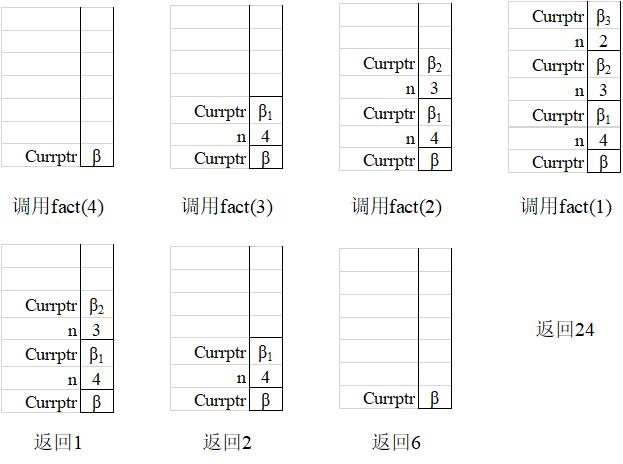
  使用4来调用该函数,那么它在栈中的流程如图F1所示。其中,β\beta表示程序调用fact的指令所在的地址。注意到,在第一次调用时,必须把地址β\beta存放入栈,并且把4传递给函数。接下来再一次调用时,注意函数的返回值是nfact(n1)n * fact(n-1),因此nn的当前值4连同需要将这次调用的指令地址β1\beta_1一同保存入栈,并且把3传递给函数。此后过程类似。返回时,将每一活动记录弹出栈并相乘,逐次累积。
F1.递归函数在栈中的实现流程示例
  这样的过程经常需要耗费大量的时间和空间,因此某些时候(但不总是)用迭代来代替递归


二 队列

  队列是限定元素只能从队尾插入的线性表。

一些术语

  • 入队-从队尾插入元素。
  • 出队-从队首删除元素。
单击此处查看队列的抽象类声明

  下面是从教材中摘录的队列的抽象类声明。

1
2
3
4
5
6
7
8
9
10
11
12
13
14
15
16
17
18
19
20
21
22
23
24
25
26
27
28
// Abstract queue class
template <typename E> class Queue {
private:
void operator =(const Queue&) {} // Protect assignment
Queue(const Queue&) {} // Protect copy constructor

public:
Queue() {} // Default
virtual ~Queue() {} // Base destructor

// Reinitialize the queue. The user is responsible for
// reclaiming the storage used by the queue elements.
virtual void clear() = 0;

// Place an element at the rear of the queue.
// it: The element being enqueued.
virtual void enqueue(const E&) = 0;

// Remove and return element at the front of the queue.
// Return: The element at the front of the queue.
virtual E dequeue() = 0;

// Return: A copy of the front element.
virtual const E& frontValue() const = 0;

// Return: The number of elements in the queue.
virtual int length() const = 0;
};

(一)顺序队列

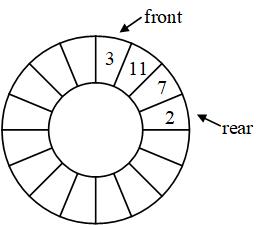
  由于顺序队列的顺序性,如果仅仅是简单地变化顺序表,执行出队/入队操作的效率总是不尽人意,因为无论如何排列,总是有出队/入队操作之一需要将原本的元素全部移动一位。这样的问题可以通过移动队列来解决,也就是说在出队时,其他元素都不移动,放宽了队列的所有元素都必须处于数组前n个位置的条件,入队时仍然将元素添加至队尾,然而这很容易造成数组中靠后的空间耗尽。实际上,如果数组是循环的,那么这个问题就迎刃而解了,如图F2所示。
F2.使用循环数组实现顺序队列示例
  如果数组的长度是size,那么数组的位置索引从0size-1,并且size-1的位置被定义为位置0(等价于位置size%size)的前驱。

如何判断循环数组是空的还是满的?
  如果我们用下面的策略来判断:

  • 空队列判定-rear表示的位置是front表示位置的前驱(rearfront表示的位置相同时,表示有且仅有1个元素);
  • 满队列判定-rear表示的位置是front表示位置的前驱(rear位于size-1的位置,front位于0的位置)。

  注意到,仅凭rearfront的位置无法判断队列空/满。一个很直接的办法是新定义一个成员变量记录元素个数(或者至少有一个布尔变量指示队列是否为空);还有另一个办法被教材选用,就是将数组的大小设置为n+1,但只允许存储至多n个元素。后者的实现办法如下。

单击此处查看顺序队列的实现

  下面是从教材中摘录的顺序队列的实现。

1
2
3
4
5
6
7
8
9
10
11
12
13
14
15
16
17
18
19
20
21
22
23
24
25
26
27
28
29
30
31
32
33
34
35
36
37
38
39
40
41
42
43
44
45
46
47
48
// This is the file to include in your code if you want access to the
// complete AQueue template class

// First, get the declaration for the base stack class
#include "queue.h"

// This is the declaration for AStack.
// Array-based queue implementation
template <typename E> class AQueue: public Queue<E> {
private:
int maxSize; // Maximum size of queue
int front; // Index of front element
int rear; // Index of rear element
E *listArray; // Array holding queue elements

public:
AQueue(int size =defaultSize) { // Constructor
// Make list array one position larger for empty slot
maxSize = size+1;
rear = 0; front = 1;
listArray = new E[maxSize];
}

~AQueue() { delete [] listArray; } // Destructor

void clear() { rear = 0; front = 1; } // Reinitialize

void enqueue(const E& it) { // Put "it" in queue
Assert(((rear+2) % maxSize) != front, "Queue is full");
rear = (rear+1) % maxSize; // Circular increment
listArray[rear] = it;
}

E dequeue() { // Take element out
Assert(length() != 0, "Queue is empty");
E it = listArray[front];
front = (front+1) % maxSize; // Circular increment
return it;
}

const E& frontValue() const { // Get front value
Assert(length() != 0, "Queue is empty");
return listArray[front];
}

virtual int length() const // Return length
{ return ((rear+maxSize) - front + 1) % maxSize; }
};

(二)链式队列

  与顺序队列不同,链式队列不具有顺序性,因而在链表的基础上只需进行简单的变化。它与链式栈不同——链式栈只需要在栈顶执行入栈/出栈操作,对特殊情况(例如空队列)执行入栈/出栈操作时,只需要改变top指针即可,top指针所指的结点的data域是入栈元素,next域是原来的栈顶元素。

  在实现链式队列时,使用头结点可以简化实现方式和对特殊情况(例如空队列)的操作,这是因为链式队列需要对队首和队尾进行操作。以向空队列插入元素为例:

  • 如果不使用头结点,那么在首次入队时,需要判空,并且改变frontrear指针指向新插入的元素,此后插入元素便在rear指针后加入元素并改变rear指针;
  • 如果使用头结点(初始化时,frontrear指针都指向头结点),那么无论是否时首次入队,都不需要判空,只需要在rear指针后加入元素并改变rear指针。

  实际上,top指针和rear指针是很相似的,对于插入元素而言,前者是在指针前插入元素并改变指针,后者是在指针后插入元素并改变指针。头结点在这里只是优化了front结点的相关操作。

单击此处查看链式队列的实现

  下面是从教材中摘录的链式队列的实现。

1
2
3
4
5
6
7
8
9
10
11
12
13
14
15
16
17
18
19
20
21
22
23
24
25
26
27
28
29
30
31
32
33
34
35
36
37
38
39
40
41
42
43
44
45
46
47
48
49
50
51
52
53
54
55
56
// This is the file to include in your code if you want access to the
// complete LQueue template class

// Include the link class
#include "link.h"

// First, get the declaration for the base stack class
#include "queue.h"

// Implementations for linked queue function members
// Linked queue implementation
template <typename E> class LQueue: public Queue<E> {
private:
Link<E>* front; // Pointer to front queue node
Link<E>* rear; // Pointer to rear queue node
int size; // Number of elements in queue

public:
LQueue(int sz =defaultSize) // Constructor
{ front = rear = new Link<E>(); size = 0; }

~LQueue() { clear(); delete front; } // Destructor

void clear() { // Clear queue
while(front->next != NULL) { // Delete each link node
rear = front;
delete rear;
}
rear = front;
size = 0;
}

void enqueue(const E& it) { // Put element on rear
rear->next = new Link<E>(it, NULL);
rear = rear->next;
size++;
}

E dequeue() { // Remove element from front
Assert(size != 0, "Queue is empty");
E it = front->next->element; // Store dequeued value
Link<E>* ltemp = front->next; // Hold dequeued link
front->next = ltemp->next; // Advance front
if (rear == ltemp) rear = front; // Dequeue last element
delete ltemp; // Delete link
size --;
return it; // Return element value
}

const E& frontValue() const { // Get front element
Assert(size != 0, "Queue is empty");
return front->next->element;
}

virtual int length() const { return size; }
};

(三)顺序队列和链式队列的比较

  实现顺序队列和链式队列的所有操作都只需要常数时间,因此它们的时间效率接近。在空间效率方面,它们和顺序栈与链式栈的比较是相似的,不过顺序队列不能在一个数组中存储两个队列,除非二者数据项从一个队列转入另一个队列。